
Introduction
Managed hosting for investor relations services is the infrastructure behind your filings, press releases, stock data, and every digital touchpoint investors use to evaluate your company. IR teams often struggle to compare quotes that look similar on paper but cover very different scopes of work.
Pricing depends on website complexity, traffic during earnings releases, uptime and security requirements, data feeds, webcast needs, and whether you're buying hosting alone or as part of a bundled IR platform.
A $299/month starting quote and a $1,000-$2,500/month subscription might both claim to cover "IR hosting," yet solve entirely different problems.
This article breaks down current U.S. pricing benchmarks, what's typically included versus billed separately, the factors that push costs up or down, and the questions your team should ask before signing anything.
Key Takeaways
- Treat managed IR hosting as a recurring technology and service cost, not a flat hosting fee
- Compare setup fees, platform pricing, usage costs, add-ons, SLAs, and renewal terms side by side
- Match platform depth to your program: lean small-cap teams need focus; event-heavy programs need scale
- Pay more when uptime, publishing accuracy, and compliance support are business-critical
How Much Does Managed Hosting for Investor Relations Services Cost? (Pricing Overview)
There's no single market price here, because "managed hosting for investor relations services" can mean anything from basic infrastructure management for an existing site to a full IR website with data, filings, and webcasts bundled in.
Misreading a quote creates real problems. Teams underbudget for essential services, compare packages that aren't actually equivalent, or discover after signing that wire distribution, premium data, migration, or webcast production cost extra.
Typical Cost Range
Published pricing tends to fall into three rough tiers, though these figures come from individual vendor pages rather than an audited market average:
| Tier | Typical Range | Billing Basis | What It Usually Covers |
|---|---|---|---|
| Entry-level / focused hosting | Starting around $299/month | Monthly subscription | Basic managed site for a smaller issuer or lean IR team |
| Mid-range / standard platform | Roughly $3,600/year for modular packages | Annual, often module-based | Hosting plus investor data, filings, releases, alerts |
| Advanced / enterprise solution | $1,000-$2,500/month or custom quote | Monthly or project-based | Multiple sites, high availability, webcasts, dedicated support |

Widgets & Web advertises a customized IR website starting at $299/month, with no upfront design fee. That's one provider's entry offer, not a promise every issuer will pay that rate.
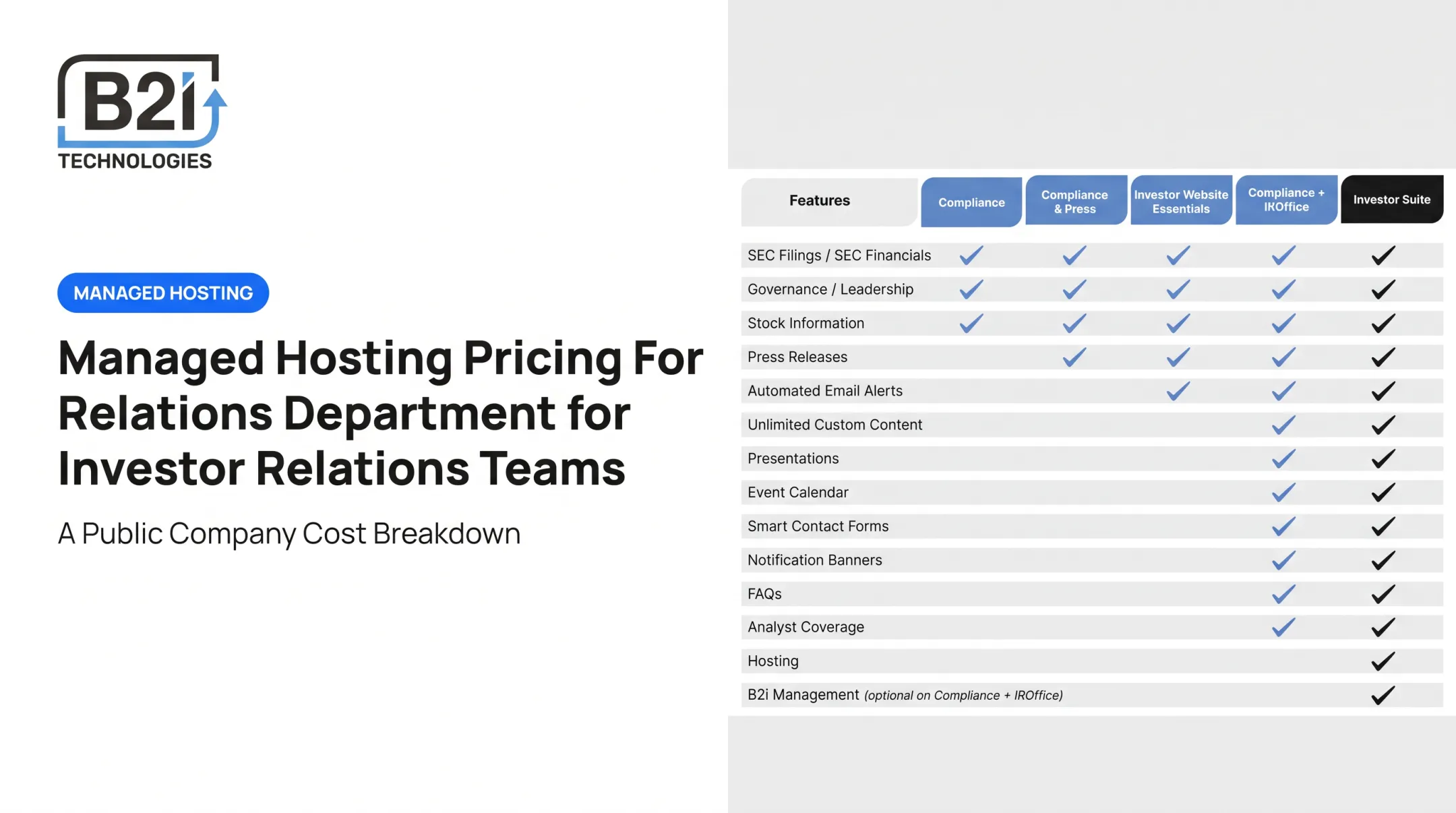
B2i Technologies lists its IR Website Essentials package at $3,600 per year. That figure buys data modules, such as SEC filings, press releases, and stock information, integrated into an existing website. It isn't a full-service hosting quote, and shouldn't be compared directly against a complete hosted site.
On the higher end, ACCESS Newswire has reported communications subscriptions averaging $1,000-$2,500 per month, spanning multiple services beyond just website hosting. Always ask whether a published range covers hosting specifically or a broader bundle.
What the Pricing Ranges Typically Include
Across most tiers, managed IR hosting typically includes:
- Server infrastructure, backups, and SSL certificates
- Security monitoring and software patching
- Support hours (ranging from business-hours to 24/7)
- Content management tools for routine updates
- Investor data feeds: filings, press releases, stock quotes
- Some level of uptime commitment
Common exclusions, unless specifically negotiated:
- Wire-service distribution for press releases
- Premium or real-time market-data licensing
- Custom design, development, or site migration
- Webcast production and event registration
- IR strategy consulting or crisis communications
B2i Technologies packages hosting with filing, press release, data, and webcast tools so teams are not juggling separate vendors. Its IR Website Maintenance Services typically include:
- Google Cloud or AWS hosting with HTTPS and multi-factor authentication
- SOC 2 compliance and a 99.99% uptime guarantee
- 24/7/365 monitoring by support staff, not a ticket-only queue
Pricing scales with project scope rather than a single fixed published rate.
Key Factors That Affect Pricing and the Full Cost Breakdown
Total cost comes down to technical requirements, how complex your investor communication workflows are, operational risk tolerance, and how much responsibility you're transferring to the provider versus handling in-house.
Website Type, Platform, and Configuration
A standalone IR microsite costs less to host than an IR section woven into a full corporate website, which in turn costs less than a multi-site or agency-managed environment.
WordPress-based builds, such as B2i's custom WordPress IR websites, price differently from proprietary CMS platforms. Custom functionality, APIs, legacy integrations, and third-party plugins all affect setup time and ongoing support needs.
Traffic, Scale, and Availability Requirements
Investor traffic spikes hard around earnings releases, major announcements, uplisting activity, and annual meetings. That changes what you need in terms of caching, redundancy, monitoring, and disaster recovery.
Vendor-published availability claims vary: some advertise 99.9% uptime, others 99.99%. Neither figure alone establishes a contractual service credit or recovery-time objective. Ask for the actual SLA terms, not just the marketing percentage.

IR-Specific Data and Publishing Services
These IR services often carry separate line items:
- Real-time stock data and historical charts
- SEC filing feeds
- Press release publishing and email alerts
- Governance content
The SEC's EDGAR system itself provides filing and XBRL data via API without requiring a key or authentication, but a vendor charging for a "filing feed" is really billing for implementation, display, and support around that data, not for SEC access itself.
Real-time quote display raises a separate licensing question. NYSE's redistribution policy states that vendors externally redistributing real-time proprietary market data need a license and applicable fees. Delayed quotes typically don't carry the same requirement. Confirm the data source, delay, and who pays the license before signing.
Security, Compliance, and Support
Expect to evaluate:
- SSL, firewall, and malware protection
- Access controls and patching cadence
- Backup frequency and disaster recovery
- Audit support and data-protection practices
B2i's hosting runs on a SOC 2-compliant data center with multi-factor authentication built in. Round-the-clock monitoring and named support contacts cost more, but they cut operational burden for a two-person IR team that can't babysit a server at 2 a.m. on earnings night.
Cost Components Beyond the Advertised Hosting Fee
Break your budget into three buckets:
- One-time costs: Setup, migration, configuration, content transfer, DNS, and launch work
- Recurring costs: Hosting, platform access, support, maintenance, security, data feeds, filing automation, and email alerts
- Usage-based costs: Wire distribution, webcast or conference-call delivery, event registration, replay hosting, traffic overages, and custom development
A lean small-cap issuer might land near the entry tier, paying mostly for hosting and basic filing automation. A more complex issuer running quarterly webcasts, multiple data feeds, and an active press release calendar will stack recurring and usage-based costs on top of a higher base platform fee.
Low-Cost vs High-Cost Managed Hosting — What's the Difference?
A lower price can work fine for a simple IR site. But the cheapest option often shifts labor, security, and downtime risk onto your team instead of eliminating it.
Performance and Availability
Lower-cost hosting typically means shared resources, limited redundancy, and thinner monitoring. That's usually fine for steady traffic, but risky on an earnings day when visitor volume spikes hard.
Higher-cost managed hosting invests in capacity planning, redundancy, and documented recovery processes built to hold up during market-sensitive announcements. B2i's hosted environment, for instance, runs on Google Cloud or Amazon Web Services (AWS) infrastructure with CloudFront distribution specifically to absorb traffic surges.
Security, Compliance, and Reliability
Budget packages often sell security as an add-on: basic backups, manual patching, limited access controls. Premium packages bake these in:
- Proactive monitoring around the clock
- Layered security with SOC 2-compliant infrastructure
- Documented incident response procedures
- Clear ownership of who handles a breach or outage
Support, Customization, and Long-Term Value
A lean team with simple needs can reasonably choose a limited package, but should expect to handle some technical work internally, like coordinating migrations or managing third-party integrations themselves.
Higher-cost platforms reduce that burden through custom integrations, human support, and bundled data, filings, releases, alerts, and webcasts in one place. B2i reports pricing that runs 30%-70% less than traditional vendor models while still including real-person support with no ticket queues. That gap matters when you weigh subscription cost against staff time spent firefighting a missed publishing deadline.

The real comparison isn't the monthly invoice. It's that invoice plus the cost of emergency fixes, migration effort down the road, and juggling multiple disconnected vendors.
How to Estimate the Right Budget for Your IR Team
Start with your actual publishing workload: filings, earnings releases, calls, annual meetings, investor days, alerts, and when traffic typically spikes.
Then build a requirements list covering:
- Current website platform and number of sites
- Market-data needs (real-time vs. delayed, licensing)
- SEC filings, press releases, and wire distribution
- Email alerts, document libraries, webcasts
- Integrations, user permissions, and security needs
- Backup, support, and SLA expectations
Request itemized proposals that separate:
- Implementation and migration assistance
- Recurring hosting
- Data and distribution
- Support and SLA coverage
- Usage fees and custom work
- Renewal pricing and cancellation terms
Vague "all-inclusive" quotes tend to hide the expensive parts.
Compare provider models honestly:
- Self-managed infrastructure — cheapest, but you own every technical problem
- General managed hosting — handles servers, not IR-specific publishing
- Agency hosting — design-focused, may lack filing automation
- IR-specific platforms — built around filings, data, and investor communications
Among IR-specific options, a modular provider like B2i fits teams that want plugins or APIs today but may need a full website later. Its architecture scales from an embedded investor section to a complete corporate and investor communications hub without a platform switch.
B2i's documented migration path from platforms like Q4 or Equisolve to WordPress is built to minimize downtime during that transition.
Define success beyond price:
- Publishing speed and accuracy
- Uptime and support responsiveness
- Search visibility
- Ability to scale around market events without a scramble
Conclusion
Managed hosting for investor relations services spans a wide range, from a focused website infrastructure package to a full platform covering data, filings, releases, alerts, webcasts, and support.
Base your budget on total cost of ownership, not the lowest advertised monthly fee. Weigh:
- Required service level
- Communication workload
- Compliance expectations
Request transparent, itemized proposals. Choose a provider that balances reliability, flexibility, and responsive human support through earnings cycles and filing deadlines.
Frequently Asked Questions
How much does managed hosting for investor relations services cost, and are there low-cost or free options?
Pricing typically runs from about $299/month for entry-level packages to several thousand dollars per year for full platforms. Free or very cheap hosting often excludes IR data feeds, security, support, and compliance safeguards, so compare total cost of ownership—not just the headline fee.
What does managed hosting for investor relations services usually include?
Most packages cover infrastructure management, security, backups, monitoring, and basic support. IR-specific inclusions, like filings, press releases, stock data, alerts, and webcasts, vary significantly by provider.
Is managed hosting separate from an investor relations firm retainer?
Generally, yes. Website hosting is a technology subscription, while strategic IR, investor outreach, and crisis communications are separate retainer services, though some vendors bundle select offerings together.
What factors have the biggest effect on managed IR hosting pricing?
The biggest drivers are website complexity, traffic volume, uptime and security requirements, data licensing, publishing workflows, number of sites, and webcast capabilities.
Do small-cap public companies need managed hosting for investor relations?
Many lean teams benefit from managed hosting because it removes server administration and keeps filings, releases, and data reliable. Simpler requirements may only need a basic package rather than a full platform.
What should an IR team ask before choosing a managed hosting provider?
Ask about SLA uptime and response terms, backup and recovery processes, security responsibilities, data ownership, publishing workflows, support access, add-on fees, renewal pricing, and scalability for earnings and corporate events.