
Introduction
A hosting invoice for an investor-relations website looks simple until you dig into it. That monthly line item is really the cost of keeping SEC filings, press releases, stock data, and shareholder communications live the moment investors and regulators need them.
Pricing varies widely. Basic uptime for one issuer site costs far less than stock quotes, webcast archives, and filing feeds across a multi-client roster.
Many IR teams underbudget because they treat a generic hosting plan and a specialized IR platform as interchangeable. They aren't.
Use this guide to budget with clearer numbers and compare proposals on equal terms. It covers:
- Current US pricing ranges by service level
- What is typically included at each tier
- Cost drivers that push quotes higher
- A side-by-side method for evaluating vendors
Key Takeaways
- Specialized IR hosting bundles typically run $699–$899/month; generic CMS hosting costs less but omits IR tools
- Price mainly tracks website complexity, data-feed integrations, and support service levels
- A lean small-cap issuer pays for far less scope than an IR firm running multiple client sites
- Low quotes often skip filing automation or event support; high quotes often bundle features you will not use
How Much Does Managed Hosting for an IR Website Cost?
There's no single sticker price for managed IR hosting. Providers bundle infrastructure, CMS access, data feeds, security, and support in different combinations, so apples-to-apples comparison is hard.
What Goes Wrong When Pricing Is Misunderstood
Three mistakes show up repeatedly:
- Underbudgeting setup and migration: moving a filing archive, reworking DNS, or rebuilding integrations can cost more than the first few months of hosting
- Comparing unlike services: a $35/month generic WordPress plan and a $700/month IR platform are not the same job
- Missing recurring add-ons: premium stock data, webcast hosting, and press-release automation often sit outside the base subscription
Three Pricing Bands to Budget Against
| Band | Typical Range | Best Fit | What's Usually Excluded |
|---|---|---|---|
| Basic managed hosting | ~$35–$340/month (generic CMS, non-IR) | Simple corporate sites without filing or data needs | IR data feeds, filing automation, investor alerts |
| Specialized IR hosting | ~$699–$899/month full platforms; IR data modules from ~$3,600/year on an existing site | Public companies that need filings, releases, stock data, and CMS access together | Webcasts, conference calls, strategic IR consulting |
| Enterprise/multi-site hosting | Custom, scope-based quotes (no reliable public benchmark) | IR firms running multiple issuer sites, or large-caps with complex integrations | Assume nothing is included until it is itemized |

TickerPilot lists specialized IR hosting bundles at $699 and $899 per month, covering hosting, releases, filings, alerts, and analytics. That figure is a useful reference point, but it reflects one vendor rather than the full market.
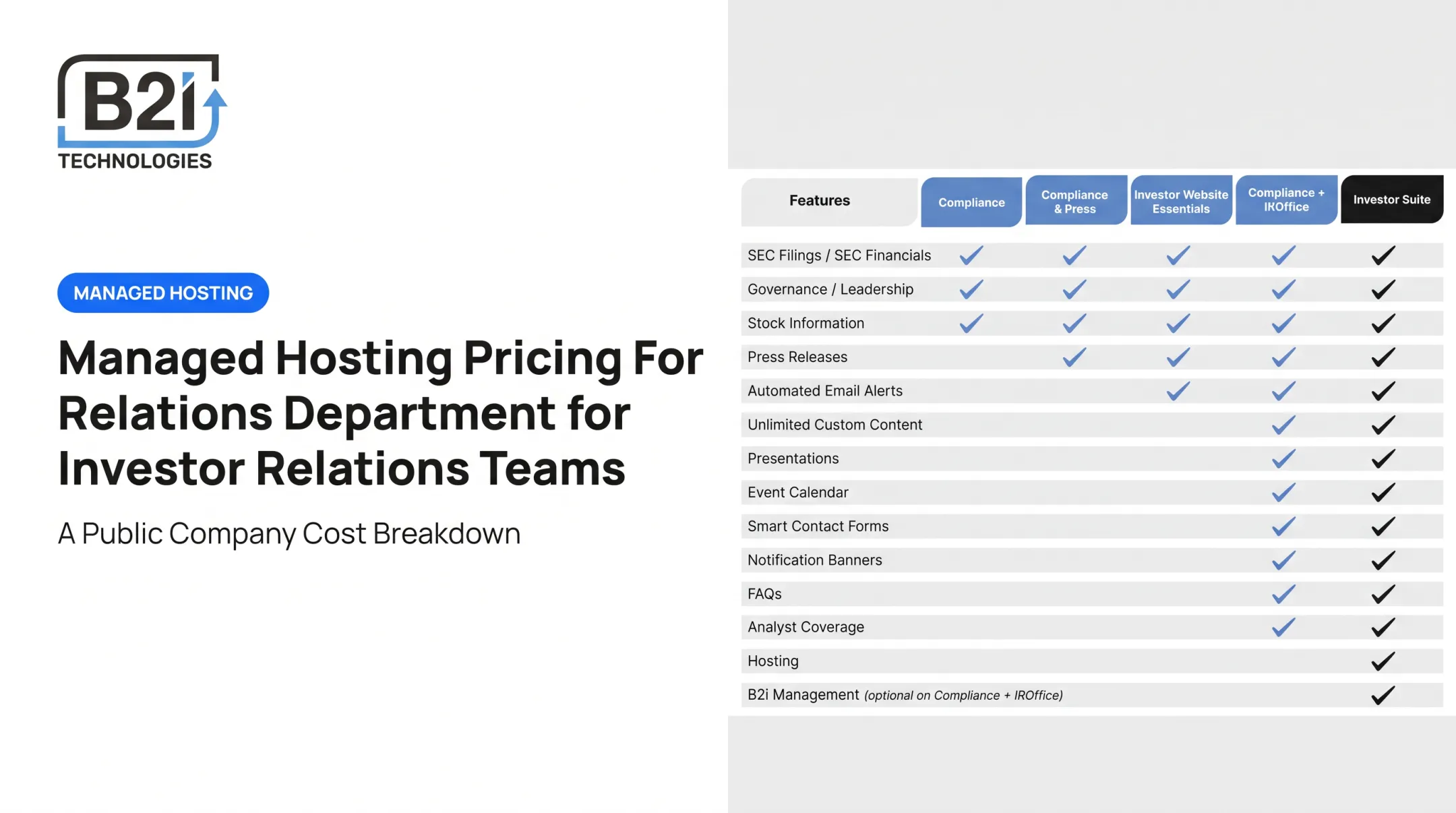
B2i Technologies' Investor Website Essentials package adds SEC filings, financials, stock information, and automated email notifications to an existing site for $3,600 per year (about $300/month). That model layers IR data onto a site the company already owns instead of hosting everything from scratch.
Full website design, content production, CRM software, wire distribution, conference calls, webcasts, and strategic IR consulting are usually priced separately from hosting. Do not assume they are bundled unless a proposal says so explicitly.
Key Factors That Affect Managed Hosting Pricing
Hosting infrastructure sets the baseline cost. Publishing tools, security, data feeds, and support are where most price differences show up.
Website Type, Number of Sites, and Configuration
A standalone IR microsite costs less to host than a fully integrated corporate-and-investor site with custom workflows. Firms managing multiple issuer websites should ask whether pricing is per-site or portfolio-based. At scale, per-site fees multiply fast.
Compare these models:
- Standalone hosting: infrastructure only, with content management handled separately
- Managed CMS with plugins: IR data added to an existing site via plugin or API, no rebuild required
- Complete website solutions: design, hosting, and IR data integrated from day one
Traffic, Storage, and Event Workload
Normal browsing traffic is predictable. Earnings day isn't. WP Engine charges $2 per 1,000 additional monthly visits on certain plans once a site exceeds its allotted traffic — a real cost driver around announcements, proxy season, and investor days.
Ask every vendor:
- Is overage billed per visit, per gigabyte of bandwidth, or per concurrent webcast viewer?
- Are webcast archives and media delivery recurring charges or usage-based?
- Does pricing change during earnings week specifically?
Security, Reliability, and Continuity
Treat these as baseline, not upgrades:
- SSL/TLS and malware protection
- Access controls and routine backups
- Documented uptime commitments
B2i's hosting infrastructure, for example, runs on Google Cloud with Amazon CloudFront distribution, SOC 2-aligned data centers, and 99.99% uptime monitored 24/7/365. Verify equivalent claims in any provider's documentation and SLA before you buy.
IR Data Feeds and Publishing Integrations
These items often carry separate licensing or add-on fees:
- Live or delayed stock quotes and historical charts
- SEC filing feeds
- Press-release wire connections
- Email alert systems
Confirm what is included versus what needs a premium third-party license or custom development before you sign.
Support, Service Levels, and Account Management
A lean IR team of one or two people rarely has an infrastructure specialist on call during a disclosure event. That is when support tier matters most.
Business-hours email support and a real person who answers during an earnings-day outage are not the same service, even when both appear as a line item on a feature list.
Cost Breakdown and Low-Cost vs. High-Cost Hosting
The advertised subscription price is rarely the whole story. Evaluate any proposal over a full 12-month period, not just the monthly rate.
Initial Setup and Migration
One-time costs often include:
- Site migration and DNS changes
- CMS configuration and content transfer
- Integration setup and testing
- Redirects and launch support
Confirm whether migration is included outright, capped at a set number of pages, or billed as a separate project. B2i's migration process, for instance, integrates existing IR content without requiring a full platform rebuild. Ask competing vendors whether they can say the same.
Ongoing Hosting and Management
Recurring costs typically cover:
- Infrastructure and monitoring
- Security patching and backups
- Storage and routine maintenance
The key question: does the provider manage the technical environment while your team keeps control over content and publishing? That division of labor affects both price and risk.
Add-Ons and Periodic Costs
Watch for charges tied to:
- Premium stock data or market feeds
- SEC filing and press-release automation
- Webcasts, transcripts, and translations
- Accessibility remediation
- Custom integrations or additional sites
Low-cost generic hosting can work fine for a low-complexity site. The risk is that it quietly shifts maintenance, security, and incident-response work onto an already lean IR team.
Higher-cost specialized hosting absorbs that technical burden. Your team keeps control over content and publishing while the provider handles infrastructure, security, and incidents—the work a specialized partner is built to take on.

How to Estimate the Right Managed Hosting Budget
Start with your actual workload, not the storage number on a pricing page.
Scope Website, Traffic, and Support Needs
List required pages, filing workflows, stock data needs, document archives, and the number of issuer websites involved. Separate must-haves from nice-to-haves: advanced analytics or custom dashboards can wait if launch timing is tight.
Then review normal traffic alongside realistic peaks: earnings releases, annual meetings, and investor days. Ask directly whether and how those peaks affect pricing and performance. Decide whether standard support covers you or whether event-day coverage is worth paying for.
Calculate Total Cost and Compare Provider Types
Build a worksheet covering setup, migration, hosting, data feeds, storage, integrations, and expected renewal increases. Ask every provider to put in writing:
- Contract length and included usage
- Overage and implementation charges
- Cancellation terms and data ownership
- Migration assistance at exit
Weigh the internal labor required to manage a generic host against the cost of a specialized IR partner that combines hosting, publishing workflows, data feeds, and support in one place. B2i's modular approach, available as plugins, an API, or a complete corporate-and-IR website, lets a team add only the capabilities it needs rather than replacing its entire web stack at once.
Budget Gaps Most Teams Miss
The real budget gaps show up in the questions nobody asked upfront:
- Focusing only on the monthly hosting line while ignoring implementation, data feeds, and internal staff time
- Assuming "managed" includes content updates, wire distribution, or webcasting without confirming scope
- Never asking how backups, disaster recovery, or urgent disclosure publishing actually get handled
- Choosing the cheapest provider without checking uptime history or experience with public-company communications
According to NYSE guidance, covered issuers must make their annual report available on or through their website simultaneously with SEC filing. Publication timing is a compliance expectation, so confirm your hosting partner can meet it.

Conclusion
Managed hosting pricing for investor-relations teams depends on website complexity, traffic patterns, integrations, security posture, and how much of the IR workflow the provider actually manages. There's no single number that applies to every issuer.
The right comparison looks at first-year total cost and ongoing cost — not just the number on the pricing page.
Before signing anything, request an itemized proposal that separates hosting, setup, data feeds, publishing, support, event services, and professional work into distinct line items. That's the only way to know what you're actually paying for.
Frequently Asked Questions
What is an IR website?
An IR website is the public source for a company's financial information, SEC filings, press releases, stock data, governance materials, event schedules, and shareholder communications. It's often a section of the corporate site or a standalone platform.
Who handles investor relations at a company?
Investor relations is the function responsible for communicating with shareholders, analysts, and the investment community. Some companies handle it internally; others work with an outside IR firm.
What is website hosting?
Website hosting stores, secures, and delivers a site's files to visitors. For IR sites, that includes filings, stock data, and press materials—the domain is only the address; hosting is the service behind it.
How much does managed hosting for an IR website cost?
Pricing varies by complexity, traffic, integrations, and support level, ranging from generic CMS hosting under $100/month to specialized IR platforms around $700–$900/month. Review the pricing bands above rather than relying on a single universal figure.
What is included in managed hosting for an IR website?
Typical inclusions cover infrastructure, monitoring, security updates, backups, support, and CMS management, sometimes alongside IR data feeds or publishing integrations. Always confirm exclusions before signing.
Is managed hosting different from an IR website platform?
Managed hosting mainly supports the technical environment. An IR website platform usually adds CMS tools, filing workflows, stock data, investor alerts, analytics, and dedicated client support on top of that infrastructure.